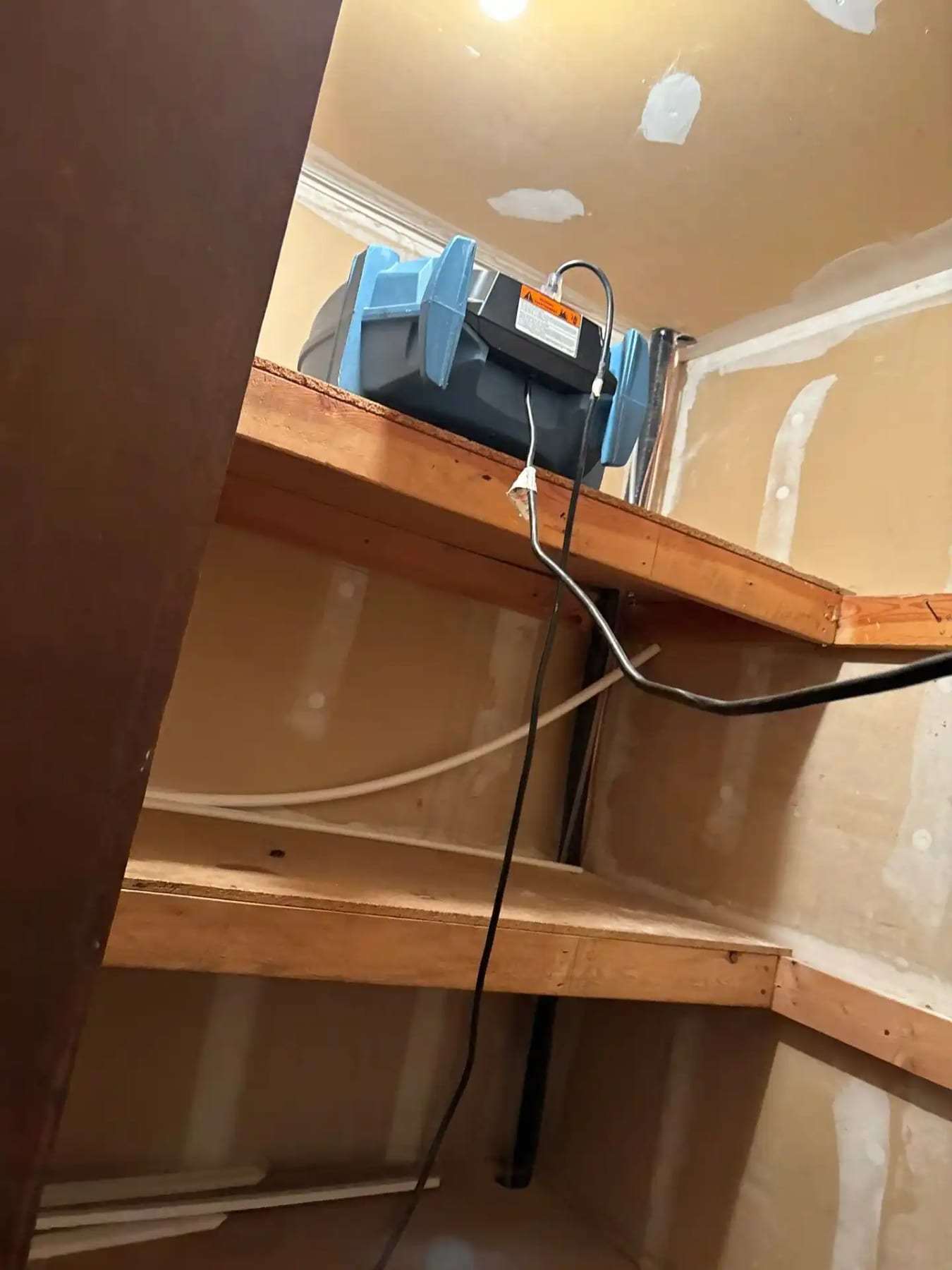
Dehumidifier drying the space under a staircase. Illustrative image of the process; it does not document a job done for this site.
Factors to weigh
| Factor | What to find out | Why it matters |
|---|---|---|
| Space size | Approximate floor area and whether rooms are open or closed off | A unit in one closed room will not dry the next room |
| How damp it gets | Your summer humidity readings at the worst spot | Higher readings call for more capacity |
| Temperature | How cool the basement or crawl space stays in summer | Some units lose efficiency or frost up in cool spaces |
| Drainage | Is there a floor drain, sump or utility sink nearby? | Continuous drainage avoids emptying a bucket daily |
| Location | Basement room, crawl space or both | Crawl spaces typically need units designed for them |
| Noise | Will people sleep or work nearby? | Compressor noise can be a reason people turn units off |
| Controls | Built-in humidistat and auto-restart after power outages | Keeps it running at a set level without attention |
| Upkeep | Filter access and cleaning instructions | A clogged filter or dirty coil reduces performance and can itself smell |
What a dehumidifier will and won't do
A dehumidifier pulls water out of the air. That slows or stops new mildew growth and lets damp materials dry over time. It does not remove odor already absorbed into carpet, pad, drywall or boxes, and it does not stop water coming through a wall. If the smell continues after weeks of good readings, the source is in materials or plumbing, not the air.
Basement units with a hose connected to a floor drain or a condensate pump are far more reliable than units with a bucket, because a full bucket shuts the machine off. Set the humidistat to keep the space in the healthy range rather than running it at maximum all the time, and compare its built-in display to a separate hygrometer, since built-in sensors vary.
Setup checklist
- Place the unit centrally with open space around it, not tucked behind boxes.
- Close basement windows and the basement door while it runs.
- Route the drain hose downhill to a drain, or use a pump with an overflow safety.
- Set a target humidity and check it against an independent hygrometer.
- Clean the filter on the schedule in the manual.
- Note the date on your calendar to check it each month in summer.
If someone recommends a whole-basement or crawl space system
- What humidity readings support the size you are recommending?
- Where will it drain, and what happens if the drain fails?
- Does it need a dedicated electrical circuit?
- Would ground cover or drainage work reduce how large a unit is needed?
General information for Lakewood, not a quote or professional advice. In an emergency, call 911.