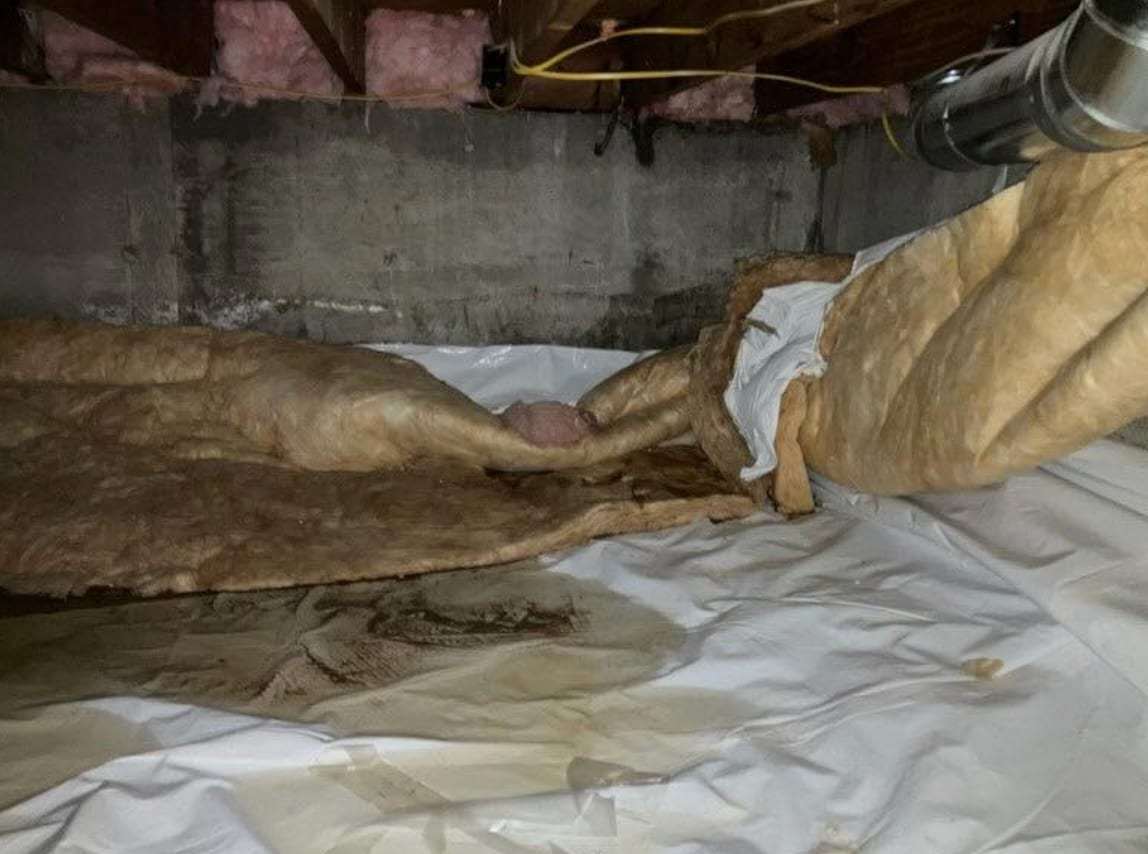
Crawlspace with sagging wet insulation over a vapor barrier. Illustrative only: this photo is not from a job tied to this site or a specific address.
Warm air rises, and it has to be replaced
Heated air in a house leaks out near the ceiling: around attic hatches, recessed lights and bath fans. Every cubic foot that escapes up top is replaced by air pulled in low, and in a ranch built over a crawl space the lowest openings are in the floor itself. Builders call this the stack effect. The result is a slow, steady draft from the crawl space into the rooms above.
Bedrooms often get more than their share. They tend to sit at the far end of the house, over the part of the crawl space farthest from the access hatch, where nobody looks. Plumbing for a hall bath, heating ducts and wiring all pierce the subfloor there. Each hole is a small chimney carrying whatever the crawl space smells like.
Many Lakewood ranches from the 1950s and 1960s were built with dirt floors under them, sometimes with a thin plastic sheet that has since torn or shifted. Soil releases moisture continuously, and the cool, still air under the floor holds it. Wood framing, the paper face of fiberglass batts and any debris left by builders can all start to smell under those conditions.
Tracing the path from crawl space to bedroom
A flashlight, a hygrometer and a helper make this easier.
- Find the strongest room.Close bedroom doors overnight, then open each one in the morning and note which smells worst. That room usually sits over the wettest part of the crawl.
- Look up from below.From the hatch, shine a light toward that room's footprint. Note bare soil, puddles, sagging insulation or dark staining on joists.
- Find the holes.In the bedroom and nearby bath, check where pipes enter through the floor, the gaps around heating registers and the edges of baseboards on exterior walls.
- Check the ducts.Ductwork in a crawl space with loose joints can pull crawl air straight into the supply or return. A musty puff when the furnace starts is a clue.
- Record readings.Compare humidity in the crawl space and in the bedroom over a week. A crawl space reading well above the house reading confirms where moisture is coming from.
Common leak points and what they usually need
| Opening | Why it matters | Typical correction |
|---|---|---|
| Plumbing penetrations | Large holes cut for drains often left unsealed | Fire-rated sealant or foam, inspected by a plumber if pipes are old |
| Heating register boots | Gap between duct boot and subfloor pulls crawl air | Seal boot to floor with mastic or foil tape |
| Duct joints in the crawl | Return ducts under suction draw crawl air | Seal seams; have an HVAC technician check return design |
| Bottom plates on exterior walls | Air slips under baseboards | Seal from below where reachable |
| Access hatch inside the house | Poorly fitted interior hatch acts as a vent | Weatherstrip and latch the lid |
General information for Lakewood, not a quote or professional advice. In an emergency, call 911.